
Report of the Interfaith Dialogue Among Christian, Buddhist, and Hindu ScholarsMeeting on
Report of the Interfaith Dialogue Among Christian, Buddhist, and Hindu ScholarsMeeting on: “Seeking a Unified Framework and Common Protocol for Addressing Crises”
On Thursday, November 20 (15:00), religious scholars from Christianity, Hinduism, and Buddhism — Mr. Lionel, Mr. Darshaka Sharma, and Mr. Kal Pahane — met with Hojjatoleslam Sadaqati and Mr. Ali Kebreai-zadeh, Cultural Counselor of the Embassy, for a discussion on “seeking a unified framework and a common protocol for responding to crises.”
Report of the Interfaith Dialogue Among Christian, Buddhist, and Hindu ScholarsMeeting on: “Seeking a Unified Framework and Common Protocol for Addressing Crises”
On Thursday, November 20 (15:00), religious scholars from Christianity, Hinduism, and Buddhism — Mr. Lionel, Mr. Darshaka Sharma, and Mr. Kal Pahane — met with Hojjatoleslam Sadaqati and Mr. Ali Kebreai-zadeh, Cultural Counselor of the Embassy, for a discussion on “seeking a unified framework and a common protocol for responding to crises.”
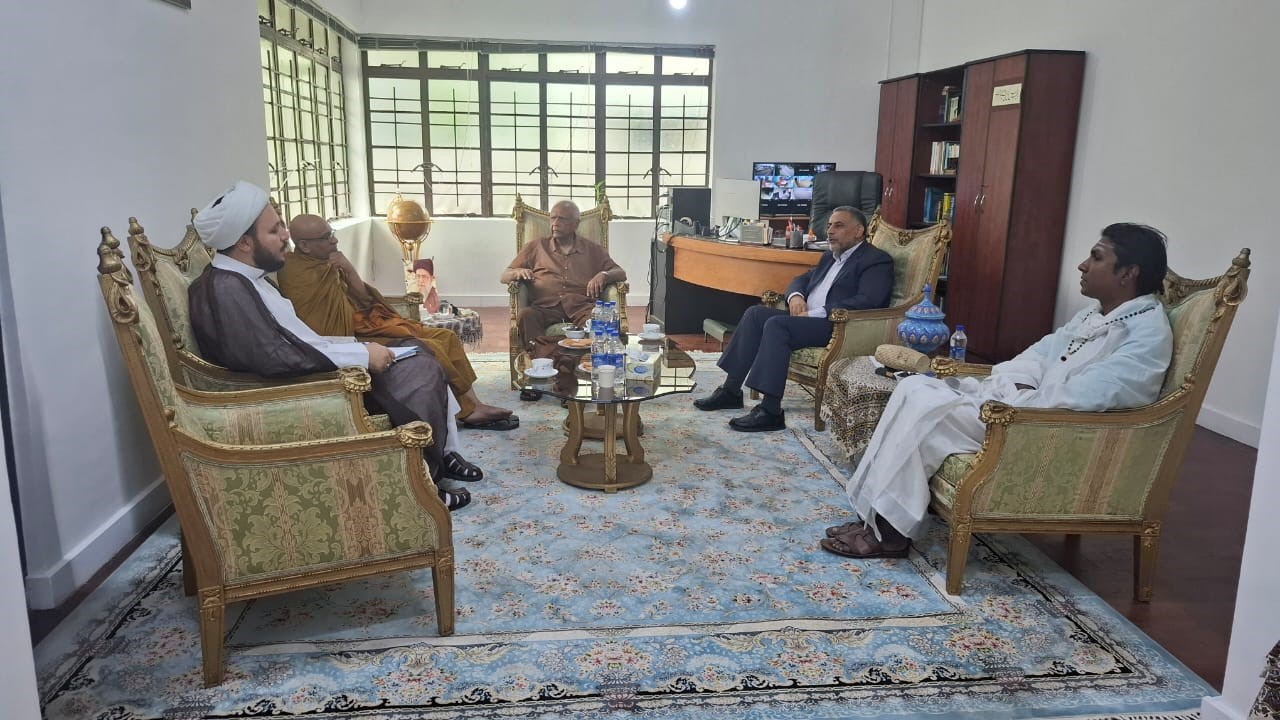
At the beginning of the session, Mr. Kebreai-zadeh welcomed the participants and referred to the activities and mission of the Cultural Counsellor’s Office in the field of interfaith engagement. He emphasized that the presence of religious thinkers at the Counsellor’s Office reflects a spirit of solidarity and expresses our shared concern and determination to confront threats that, unfortunately, endanger human life today.During the discussion, Mr. Lionel described the presence of Israel in Sri Lanka — which is heavily protected — as a serious threat to his country. He stressed the need to promote solidarity and a culture of resistance in such conditions. He added that “the crisis of our time is the crime being committed by Israel in Gaza — the killing of innocent people across different parts of the world,” and stated that religious leaders cannot merely limit themselves to dialogue.
Mr. Kal Pahane argued that Western powers are actively removing ethics from societies, attempting to discredit religious values. Therefore, promoting moral and religious principles — which all faiths emphasize — and confronting what the Supreme Leader of Iran calls “cultural invasion” is of great importance. He also highlighted the significance of strengthening cultural relations between Iran and Sri Lanka, noting that Iran is committed to promoting morality and interfaith harmony both in thought and practice.Mr. Darshaka Sharma expressed concern that extremist religious currents distort the true image of Iran. In response, Hojjatoleslam Sadaqati emphasized the necessity of presenting and clarifying the essence of true Islam.
At the conclusion of the meeting, the participants agreed on the necessity of focusing on three key actions, which will be pursued in future sessions:
3- Establishing an Interfaith Council aimed at implementing joint spiritual projects and programs, coordinating shared responses to crises, and recognizing worship as a form of social service.
2-Strengthening moral values by defining and developing a shared ethical framework to counteract foreign moral corrosion.
3-Enhancing cultural relations between Iran and Sri Lanka, with the goal of promoting both Iranian and Sri Lankan cultural and ethical values.
